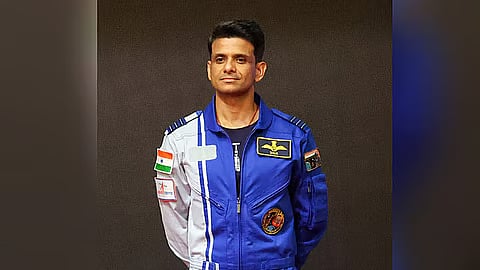

Bengaluru: Astronaut and IAF Group Captain Shubhanshu Shukla on Saturday reminisced about being aboard the International Space Station on this day last year, where he successfully completed a challenging STEM demonstration assigned by ISRO after struggling for five days.
Speaking at the launch of his book, The Second Orbit: Belief of a Man… Dreams of 1.4 Billion Hearts here, Shukla, who became the first Indian to visit the ISS, said, "Today is July 4 and last year, this day I was not on Earth. I was in space on the International Space Station."
On his time aboard the ISS, he recalled a STEM demonstration that he had been attempting for several days, in which ISRO had assigned him the task of creating a water bubble, injecting an air bubble inside it, and then injecting a coffee bubble inside the air bubble.
"So three bubbles in space and I had been struggling for the past five days to do that. It was very difficult for me to just capture this water bubble and today (July 4) was the day when I was successfully able to do it. I was so happy that this could finally be achieved on this day," Shukla said.
Shukla was part of a four-member crew that spent 18 days aboard the ISS as part of NASA's Axiom-4 mission. It marked the return of an Indian to space after four decades -- Wing Commander Rakesh Sharma was the first to do so in 1984.
The astronaut said he captured his first photograph of the entire Earth from the ISS through the cupola window using a special lens.
He said that all these were possible only because of the efforts of a large team on the ground.
"When we send or launch someone to space, it takes thousands of people, a huge team on ground and every single one of them matters. That is, in a sense, what this book is about, partly," he said.
The IAF Group Captain said the book is "not a celebration of an individual achievement", but seeks to highlight that accomplishing something monumental requires people to work together as a team, and that teamwork ultimately defines "how far you go" and "what great accomplishments you can do".
Shukla said he never thought that he would write a book when he landed back in India after the mission, but then he realised very soon that it was not possible for him to reach everywhere to share this story and probably writing a book would be a good way to share it.
Sharing the funniest moment of his space mission, Shukla said that while space is an environment where "life should not exist", it also throws up amusing situations.
Recalling the journey to the ISS, Shukla said the crew had about 22 hours between reaching orbit and docking with the station, giving them some time to sleep.
He explained that as there is no bed in space, and that astronauts can sleep anywhere inside the spacecraft. While his crewmates strapped themselves to their seats, Shukla chose to squeeze beneath one of the seats and, feeling cold, slipped into a large black bag meant for storing spacesuits.
"I kept going inside... till almost my shoulders were inside the bag, and I slept comfortably," he said.
But in zero gravity, Shukla said that his body slowly drifted while he was asleep, leaving only what looked like another bag in the capsule.
"When the others woke up and decided to have a meal, they couldn't find me. They saw four bags and only three crew members. For some time, it was a mystery-how can you lose someone in such a small capsule in space?" he said, drawing laughter from the audience.
Shukla said such light-hearted incidents, along with stories from his fellow astronauts, have been captured in his book to offer readers a glimpse into the human side of life in space.
According to Shukla, while he was in the Orbit, he went around the Earth 320 times and traveled a distance of about 1.4 crore kilometers during his stay in space.
"If we take 140 crore Indians, I've travelled about 100 metres for each one of you. In some sense, all of you have been a part of this journey," he said.
Former ISRO Chairman S Somanath, who was also part of the book launch event, said, while responding to a question on India's Gaganyaan mission, that it follows a much more challenging path than astronaut Shukla's flight.
"Gaganyaan is a very tough journey because, when developing a human spacecraft, you will understand the knowledge that is required to build it. It is not readily forthcoming from others. So, we need to research and find it out. Another way is to gain experience through our people who actually fly these missions and can tell us how the system needs to be designed to suit the requirements," he told reporters here.
Somanath said the experience gained through Shukla's mission would contribute significantly to the Gaganyaan programme.
He noted that ISRO would first carry out multiple uncrewed test missions before attempting a crewed launch, stressing that human spaceflight would only be undertaken after every critical issue had been understood and resolved to ensure maximum safety.
This report was published from a syndicated wire feed. Apart from the headline, the EdexLive Desk has not edited the copy

