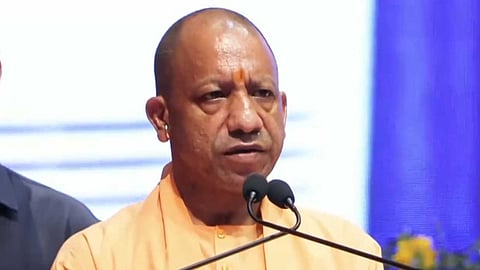

Varanasi: Uttar Pradesh Chief Minister Yogi Adityanath on Wednesday said anganwadi centres and basic education schools will serve as the foundation for building a healthy, educated and self-reliant India.
He was speaking at the launch of the ninth Poshan Maah programme here.
The Rashtriya Poshan Maah (National Nutrition Month) is observed every September as a dedicated platform to mobilise communities and reinforce key nutrition, health and care-giving behaviour among pregnant women, lactating mothers, children, adolescents, and their families.
Adityanath said the government's focus on nutrition and strengthening anganwadi centres reflected Prime Minister Narendra Modi's vision of laying a strong foundation for India's development.
He said the transformation in the functioning of anganwadi centres in Uttar Pradesh was visible during his visits to districts, where he regularly inspects Bal Vatika facilities and observes activities there.
"The change we see today is the result of Prime Minister Narendra Modi's vision. He took steps in 2014 to strengthen the foundation of the country, building on the work he had implemented on the ground in Gujarat since 2001," Adityanath said.
"The same vision that began in Gujarat in 2001 is today being implemented across the country, and Uttar Pradesh is also moving forward in this direction," he said.
Drawing a parallel with the concept of Ram Rajya, the chief minister said it envisioned a society free from poverty and deprivation, where people were healthy and capable of contributing to the creation of a strong nation.
He questioned why such a vision had not translated into effective ground-level action before 2014, particularly for poor families, malnourished children and pregnant women whose health was directly linked to India's future.
Adityanath said the launch of the ninth nutrition month, coinciding with the completion of 10 years of the Matru Vandana Yojana, was an opportunity to further strengthen efforts aimed at improving nutrition and maternal and child welfare.
Referring to the condition of anganwadi centres before 2017, he said many were in dilapidated and unhygienic conditions, lacked drinking water and toilets, and did not provide hot meals or nutrition supplements on time.
"Before 2017, many anganwadi centres were in a pathetic condition. Children would carry their own mats to sit on; there was no proper drinking water, no toilet and no hot meal," he said.
He said an inquiry after his government came to power revealed serious irregularities in the supply of nutritious food to anganwadi centres, with poor-quality supplies and long delays in delivery.
"The fault was committed by someone else, but the anganwadi workers bore the brunt of it. Their honorarium was only Rs 3,000, while helpers received just Rs 1,500," Adityanath said.
The chief minister said the situation had now changed, with the government developing a model for anganwadi centres and undertaking their renovation and improving transportation and other facilities.
"Today, the situation has changed. We have developed a model for anganwadi centres, renovated them and ensured proper supply of facilities," he said.
He added that anganwadi workers had been provided smartphones, enabling real-time uploading of data and monitoring of nutrition distribution and its quality.
Adityanath said around 70,000 anganwadi centres had been given a new form in Uttar Pradesh over the past nine years, with every centre being kept among the government's priorities.
"Anganwadi centres are no longer just centres for nutrition; they are becoming centres of education as well," he said.
He said these centres and schools run by the Basic Education Council could become the starting points for the prime minister's vision of an India that is self-reliant and developed by the time the country completes 100 years of Independence.
"The foundation of a capable and educated India, a healthy and empowered India, and a self-reliant and developed India begins here," Adityanath said.
He said the theme of this year's nutrition month, "Meri Anganwadi, Meri Zimmedari", underlined that responsibility for anganwadi centres could not rest with the government alone.
"Every anganwadi worker, every helper, every gram panchayat and every citizen has a responsibility. We must take ownership and turn the prime minister's vision into reality on the ground," he said.
Adityanath also described Varanasi as the spiritual and cultural capital of Sanatan tradition, and said the people of Kashi were fortunate that it is the "karmabhoomi" of Prime Minister Modi.
"Varanasi has received a new identity without losing its ancient character. Today, Kashi is attracting the entire world with a new aura and a new energy," he said.
Union Women and Child Development Minister Annapurna Devi and Minister of State Savitri Thakur were among those who attended the programme.
This report was published from a syndicated wire feed. Apart from the headline, the EdexLive Desk has not edited the copy.

