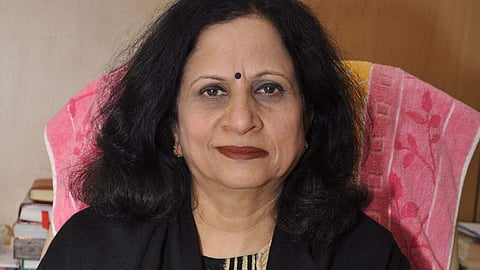

New Delhi: References from the Bhagavad Gita and other classical Indian texts have been incorporated into the curriculum at Dr B R Ambedkar University, Delhi, as part of a new 'Bharatiya Knowledge System' framework, Vice Chancellor Anu Singh Lather said.
In an interview with PTI, Lather said the university consciously chose to use the term 'Bharatiya Knowledge System' (BKS), arguing that it better reflects India's civilisational knowledge traditions than the conventional 'Indian Knowledge System' approach.
"The first correction which we made in our university was that it is not the Indian Knowledge System. We have called it Bharatiya Knowledge System because when you say Indian Knowledge System, it confines us to a certain period where India was India," she said.
Explaining how the ancient texts have been integrated into academic programmes, Lather said the university has ensured that the references are academically useful and easily accessible to students.
"If we have given a certain verse from the Bhagavad Gita, the verse number along with the page number is also there. Every student may not get time to go through the original classics, so we have made the referencing very sharp, pointed and focused so they can understand both the context and the contribution of our knowledge traditions," she said.
According to the vice chancellor, a team of scholars worked for 18 months to develop 46 BKS courses, with programme-specific content tailored to suit different disciplines.
For instance, management students study the ideas of Chanakya, while courses in the humanities, social sciences and history draw upon other classical Indian sources relevant to their fields.
She said the university hopes that the BKS courses developed at Ambedkar University will eventually be adopted by the University Grants Commission (UGC) and other higher education institutions across the country.
Lather said the initiative is part of the broader reforms introduced under the National Education Policy (NEP), which she described as a "paradigm shift" in India's higher education landscape.
"The shift comes from the shifting vision itself. The NEP is aligned with global standards and competitiveness. We have moved towards an open system of education with interdisciplinary learning, research participation, field training, experiential learning, apprenticeships and skill development," she said.
The university has also redesigned its curriculum in line with the National Credit Framework, revisiting and revamping programmes with a greater focus on employability, she said.
"Our central theme is that every programme and every course we offer should essentially prepare students for employment," Lather said.
She added that the university has introduced the one-year master's programme from this academic session, while continuing with the conventional two-year master's programme during the transition period.
Acknowledging that there could be initial uncertainty over the value of the one-year postgraduate degree, Lather said the university expects employers to gradually recognise and accept the new structure envisaged under the NEP.
This report was published from a syndicated wire feed. Apart from the headline, the EdexLive Desk has not edited the copy.

