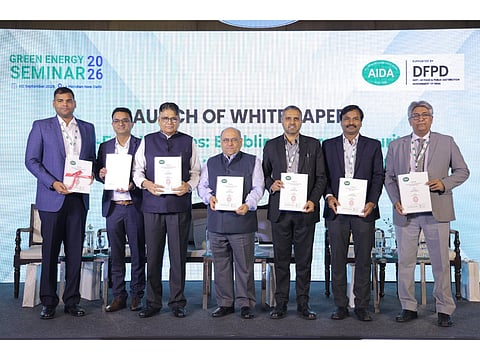

New Delhi: The All India Distillers’ Association (AIDA) and IIT Delhi have unveiled a policy roadmap for scaling Flex-Fuel Vehicles (FFVs) as India looks to expand ethanol use beyond E20, with the study focusing on vehicle technology, fuel pricing, infrastructure and consumer adoption.
The white paper, titled 'Flex-Fuel Vehicles (FFV): Enabling Energy Security and Sustainable Mobility in India,' was launched at the AIDA Green Energy Seminar 2026, bringing together policymakers, automakers, ethanol producers, fuel companies, researchers and technology experts, according to an official release.
The study examines the key requirements for developing a commercially viable FFV ecosystem, including vehicle technology, fuel pricing, infrastructure readiness, sustainable feedstock, consumer acceptance, financing and market development.
It presents a 10-point policy roadmap covering immediate and longer-term measures to support the adoption of flex-fuel vehicles.
The white paper shifts the focus beyond ethanol production to the vehicle technology and supporting ecosystem needed to use higher ethanol blends at scale, examining the key requirements for enabling flex-fuel mobility in India.
According to the release, Flex-Fuel Vehicles (FFVs) could support energy security by reducing dependence on crude oil while giving consumers greater fuel choice and making use of India's growing domestic ethanol production capacity.
Alongside the IIT Delhi study, CRID India launched a separate white paper titled 'Towards a Sustainable Bioenergy Future for India: Feedstock Security, Land-Water Balance and The Path Beyond E20'.
The paper examines how ethanol production can be expanded while balancing food security, agricultural sustainability, land use and water resources. It also looks at the “food versus fuel” debate by distinguishing between total land under major crops and the incremental land attributable to ethanol production.
The study estimates that ethanol-attributable land use stood at around 3.46 million hectares in 2023-24, equivalent to about 1.58 per cent of India's gross cropped area.
Together, the two studies look at both the supply and demand sides of India's post-E20 ethanol transition, with one focusing on sustainable feedstock availability and the other on the mobility ecosystem required to use higher ethanol blends.
The findings are expected to provide policy and technical inputs for stakeholders as India considers the next phase of ethanol use and flex-fuel mobility, the release said.
This report was published from a syndicated wire feed. Apart from the headline, the EdexLive Desk has not edited the copy.

