

India’s education system is at a crucial moment of transformation. With the rollout of the National Education Policy (NEP), the growing presence of artificial intelligence in classrooms, and the increasing number of foreign universities establishing campuses in India, the debate around the future of education has intensified.
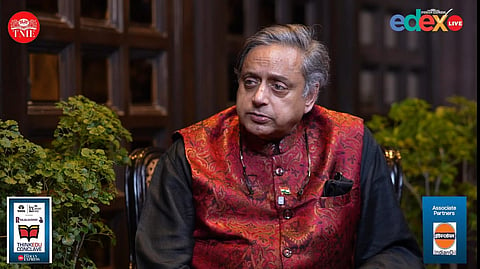
In this exclusive conversation with EdexLive, Shashi Tharoor, a seasoned parliamentarian, celebrated author, and former international diplomat, shares his perspectives on how India can navigate these changes while safeguarding quality, accessibility, and academic integrity.
The Challenge of Implementing the National Education Policy
According to Tharoor, while the vision of the NEP is commendable, implementation remains the biggest challenge, with ground realities of Indian schools often making them difficult to achieve. He notes, “For example, a number of schools do not fulfill the requirements of things like playgrounds and so on. It is not realistic to expect children to travel to some other school 30 kilometers away that has a playground.”
Another key concern is financing. The NEP encourages students to explore diverse subjects, from mathematics to music, but this diversity comes with additional costs. As Tharoor explains, teaching mathematics requires relatively simple resources: a teacher and a blackboard. However, music education demands instruments, trained instructors for different specialisations, and dedicated spaces, all of which require funding.
This raises an important question: who will bear these costs? If the financial burden falls on parents, it could exclude students from less privileged backgrounds. On the other hand, if schools must absorb the costs, many institutions may struggle to provide such facilities. Unless these financial realities are addressed, Tharoor cautions, the aspirations of the NEP may remain difficult to fully realise.
At the university level, Tharoor expresses a more optimistic outlook. One aspect of the NEP he particularly appreciates is the new academic flexibility it offers students. The policy allows learners to major in one discipline while exploring courses in other fields, encouraging interdisciplinary learning. For example, a student pursuing humanities can also study science, or vice versa. Tharoor believes this approach reflects the way knowledge works in the real world, interconnected rather than isolated.
However, he notes that universities are still grappling with the practical implementation of these reforms. While the idea is promising, successful models of interdisciplinary structures are still evolving. Another issue he highlights is the lack of genuine autonomy for universities.
According to Tharoor, institutions should have greater freedom to design curricula, determine course combinations, and take responsibility for their academic outcomes. At present, he feels that the system is still heavily regulated, with excessive control over processes rather than sufficient evaluation of results. For India’s universities to truly flourish, he argues, academic independence must go hand in hand with accountability.
With artificial intelligence increasingly entering classrooms, educators are facing a new dilemma: how to use technology effectively without compromising learning. Tharoor sees clear advantages in AI when it is used as a supportive tool. It can assist with research, help refine language and expression, and provide access to a wider range of reference material than what might be available in a traditional school library.
Yet he also warns of a potential danger. If students rely on AI to complete assignments or generate their homework, they may bypass the very process that education is meant to cultivate, the ability to think critically.
“Learning requires intellectual effort,” he suggests. “If AI becomes a substitute for thinking rather than a supplement to it, students lose the opportunity to train their minds.” In his view, the key lies in judicious use. Technology should empower students, not replace their intellectual engagement. When used responsibly, AI can enrich learning. But if it begins to dominate the learning process, it risks undermining the very purpose of education.
The idea of foreign universities establishing campuses in India has generated both enthusiasm and debate. Tharoor supports the move, viewing it as a practical response to a long-standing reality: thousands of Indian students already travel abroad each year in search of quality higher education. In fact, Indian families collectively spend billions of dollars annually on overseas education.
According to Tharoor, this represents not only a financial outflow but also a loss of talent. “Our Indian parents spent $5.2 billion last year in sending their children abroad to foreign education. To my mind, that's a real waste of resources as well as talent,” Tharoor says.
The global nature of this trend became particularly visible during the Russia–Ukraine conflict, when thousands of Indian students had to be evacuated from universities abroad, revealing how widely dispersed Indian students are across international institutions. Tharoor argues that if globally recognised universities establish campuses in India, they could provide similar quality education within the country itself.
This would offer families an alternative: rather than sending students abroad, they could access comparable academic opportunities at home. At the same time, he emphasises that India already has excellent institutions, both public and private. Institutions such as the University of Delhi, where Tharoor himself studied, have produced generations of accomplished graduates.
The challenge, however, lies in the gap between demand and supply. India has millions of students seeking higher education, yet the number of high-quality institutions remains limited. Expanding the ecosystem, including through international collaborations, could help bridge that gap. Ultimately, Tharoor envisions a future where India becomes a global hub for education, attracting not only domestic students but also learners from around the world.
The conversation highlights a central theme: India’s education reforms are ambitious, but their success will depend on thoughtful implementation. Infrastructure, funding, institutional autonomy, responsible use of technology, and expanded educational opportunities all play a role in shaping the system’s future.
As Shashi Tharoor suggests, the goal should be an education ecosystem where students have access to diverse learning experiences, universities enjoy meaningful academic freedom, and India emerges as a destination for world-class education. Achieving that vision will require not only policy innovation but also practical solutions on the ground, ensuring that the promise of reform translates into real opportunities for students across the country.
