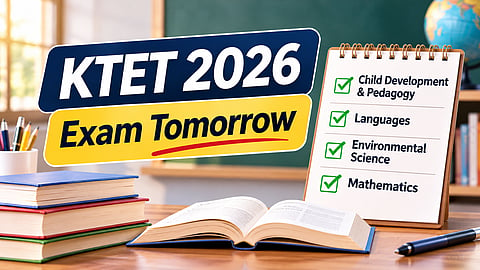


The Kerala Teacher Eligibility Test (KTET) September 2026 will commence tomorrow, November 14, with Category I and Category II examinations scheduled for the first day. Categories III and IV will be conducted on November 15.
According to the schedule published by Kerala Pareeksha Bhavan, the Category I examination, intended for candidates seeking eligibility to teach Classes I to V, will be held from 10 am to 12.30 pm on November 14.
With less than a day remaining, aspirants can prioritise important concepts identified in the State Council of Educational Research and Training (SCERT) Category I syllabus and sample question paper instead of attempting to cover new topics.
The Category I examination comprises 150 multiple-choice questions carrying 150 marks, with five sections accounting for 30 marks each.
The 30-mark section covers child development, inclusive education and learning pedagogy.
Candidates should revise:
Piaget, Vygotsky, Bruner and Kohlberg
Pavlov's and Skinner's conditioning theories
Gardner's multiple intelligences
Growth and development principles
Inclusive education and learning disabilities
Continuous and Comprehensive Evaluation (CCE)
Assessment for learning versus assessment of learning
Motivation and Maslow's theory
The SCERT model paper includes questions on developmental stages, Guilford's intelligence model, classroom inclusion and defence mechanisms.
Last-minute tip: Practise identifying the most appropriate teacher response in classroom situations. The sample questions place considerable emphasis on practical teaching decisions.
Candidates appearing for Malayalam, Tamil or Kannada should revise the syllabus prescribed for their chosen language.
The syllabus identifies four broad areas: prose comprehension, poetry comprehension, language teaching methods, and language, literature and culture.
For Tamil and Kannada, the syllabus assigns five questions each to prose and poetry comprehension, with ten each for pedagogy and language-related topics.
Last-minute tip: Review grammar rules, literary forms, common expressions and teaching methods. Practise a few comprehension questions rather than attempting extensive new reading.
For candidates opting for English, the syllabus allocates 15 marks to language comprehension and 15 marks to language pedagogy.
Important revision areas include:
Articles, tenses and prepositions
Subject-verb agreement
Question tags and auxiliary verbs
Phrasal verbs and determiners
Synonyms, antonyms and vocabulary
Language acquisition versus language learning
Constructivism and social constructivism
Methods of assessing language skills
The official sample questions include passage-based exercises, grammar and vocabulary.
Last-minute tip: Revise common grammatical errors and practise unfamiliar reading passages. Candidates should not overlook language pedagogy while concentrating on grammar.
The Environmental Science section allocates 20 questions to subject content and ten to pedagogy.
Important content areas include water conservation, pollution, food and nutrition, plants, animals, diseases, agriculture, energy, the solar system and basic scientific principles.
The SCERT sample paper includes questions on food chains, water pollution, nutrition and the principle of levers.
Last-minute tip: Concentrate on familiar environmental concepts and their classroom applications. Revise experiments, field trips, project-based learning and methods used to develop scientific thinking among primary-school children.
The Mathematics syllabus primarily draws upon concepts taught in Classes I to V, although some questions may extend these concepts.
Candidates should revise:
Natural numbers, factors and multiples
Fractions and decimals
Basic arithmetic operations
Area and perimeter
Time, money and measurements
Geometrical figures and patterns
Inductive and deductive teaching methods
Error analysis and remedial teaching
The model paper includes questions on journey-time calculations, fractions, multiplication concepts and geometrical reasoning.
Last-minute tip: Practise straightforward numerical problems while revising how mathematical concepts should be introduced to primary-school children.
Candidates can divide their remaining revision time between pedagogy, language concepts, arithmetic and Environmental Science.
The SCERT sample paper is particularly useful for understanding the nature of questions. For example, classroom-based questions often require candidates to select the most suitable teaching strategy rather than simply recall a definition.
Aspirants should also revise concepts they frequently answer incorrectly in mock tests.
Attempting lengthy new study material immediately before the examination may be less useful than reviewing familiar concepts and correcting recurring mistakes.
The Category I examination will take place from 10 am to 12.30 pm, followed by Category II from 2 pm to 4.30 pm.
Candidates should check the reporting time, examination centre and identification requirements printed on their hall tickets.
The examination will use OMR answer sheets. Candidates should follow the marking instructions prescribed by Kerala Pareeksha Bhavan.
The official website, ktet.kerala.gov.in, provides access to the examination schedule, syllabus and model question papers.
Candidates are advised to complete their revision early and avoid last-minute changes to their examination strategy.