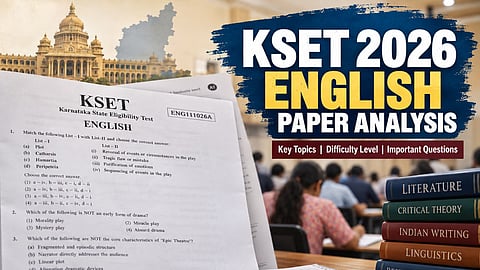


The Karnataka State Eligibility Test (KSET) 2026 English examination, conducted on Sunday, October 11, tested candidates across a wide range of literary periods, critical theories and language-related concepts. An analysis of the question paper suggests that candidates needed both strong factual knowledge and the ability to interpret literary passages, identify theoretical concepts and establish chronological relationships.
The English paper included 100 multiple-choice questions, covering British literature, Indian writing in English, world literature, literary criticism, cultural studies, linguistics and research methodology.
A review of the question paper indicates that literary theory, criticism and research-related concepts were particularly prominent in the latter sections, while the opening questions focused more heavily on drama, literary history and textual interpretation.
Based on the questions reviewed, the paper can be provisionally assessed as moderate to difficult, particularly for candidates relying primarily on memorised author-work lists.
While several questions involved direct factual recall, others demanded close reading, conceptual understanding and the ability to distinguish between closely related theoretical terms.
Matching questions and chronological arrangements added another layer of difficulty because candidates had to evaluate multiple relationships before selecting an answer.
The Shakespeare passage required interpretation rather than simple recognition, while questions on cultural studies and research methodology tested specialised terminology.
Note: The question paper has been analysed by Sakunth Kumar Sanagavarapu MA English, B.Ed, English Literature subject expert, APSET qualified.
Question paper PDF |
British literature and literary history
Questions covered Aristotle's dramatic terminology, early forms of drama, Shakespeare, Jacobean drama, Restoration literature and major British writers.
The paper included a passage from Lady Macbeth's monologue in Macbeth, followed by questions on literary devices, tone, ambition and character interpretation.
Candidates were also tested on writers and works associated with different literary periods, including questions requiring chronological ordering and author-work matching.
Indian English literature and postcolonial writing
Indian writing received substantial attention, with questions involving R K Narayan, Raja Rao, Mulk Raj Anand, A K Ramanujan and Girish Karnad.
The paper also included questions on Chitra Banerjee Divakaruni's contemporaries and works by Indian playwrights, alongside references to Chinua Achebe and other writers outside the British literary tradition.
These questions required candidates to remember authors, texts, characters and publication sequences.
Literary criticism and cultural studies
One of the more demanding areas involved critical concepts and their associated theorists.
Questions covered T S Eliot, Matthew Arnold, John Keats, Jacques Derrida, Michel Foucault, Raymond Williams, Richard Hoggart and Stuart Hall.
Candidates encountered concepts such as objective correlative, dissociation of sensibility, negative capability, cultural materialism, post-structuralism and deconstruction.
Several questions used matching formats, requiring candidates to connect theoretical concepts with critics or schools of thought.
Linguistics and language studies
The paper included questions on phonetics, word formation, language properties, multilingualism and the relationship between language and society.
Topics included voiced and voiceless sounds, diphthongs, semivowels, phonetics branches, prefixes and suffixes, and pidgin languages.
Research methodology
The final portion of the paper featured questions on research ethics, research methods, plagiarism and interdisciplinary research.
Candidates were tested on concepts such as qualitative and quantitative research, inductive and deductive reasoning, research processes and types of plagiarism.
The paper reinforces the importance of preparing English literature as an interconnected discipline rather than studying individual authors in isolation.
Candidates preparing for future KSET examinations should give attention to literary chronology, author-work associations, criticism, Indian literature, linguistic concepts and research methodology.
Regular practice with matching questions, literary passages and chronological sequences may be particularly useful.
However, candidates should avoid treating the distribution in a single paper as a fixed blueprint for future examinations.
The analysis is based on the available KSET 2026 English question paper. The final assessment of performance and qualifying outcomes will depend on the official answer key, candidate scores and applicable eligibility criteria.
