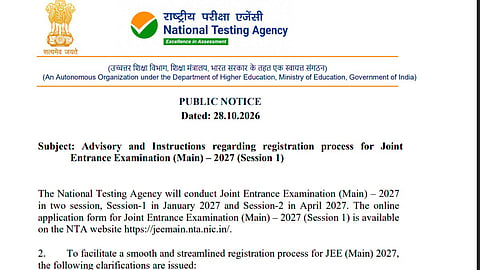


The National Testing Agency (NTA) has issued fresh instructions for JEE Main 2027 Session 1 registration, advising candidates to complete Aadhaar Re-KYC through DigiLocker before filling out their online application forms.
In a public notice dated October 28, 2026, NTA said the process would help ensure that candidates' latest details are fetched during registration. The agency has also advised applicants to use their own DigiLocker, JanParichay or e-Pramaan (MeriPehchaan) login credentials to avoid discrepancies in identity verification and biometric data at subsequent stages.
The online application form for JEE Main 2027 Session 1 is available at jeemain.nta.nic.in.
A separate DigiLocker process-flow document explains how candidates can refresh their Aadhaar information in six steps.
Step 1: Sign in to DigiLocker
Log in to your DigiLocker account and open the 'Issued Documents' section.
Step 2: Refresh the Aadhaar document
Locate the Aadhaar document, click the three-dot menu next to it and select the 'Refresh' option to initiate Re-KYC.
Step 3: Provide consent
Review the consent screen and allow Aadhaar authentication to proceed.
Step 4: Verify using UIDAI OTP
Enter the one-time password received on the mobile number registered with Aadhaar to complete authentication.
Step 5: Complete Aadhaar Re-KYC
Wait for the authentication process to finish. DigiLocker will display a confirmation once Aadhaar Re-KYC is successful.
Step 6: Refresh other documents
After completing Aadhaar Re-KYC, candidates can refresh other documents in DigiLocker to update their status.
The process-flow document notes that the screenshots are from the latest DigiLocker version and may vary slightly depending on the application version.
Apart from the DigiLocker advisory, NTA has specifically instructed candidates to ensure that their name and date of birth in the JEE Main 2027 application form match those mentioned in their Class 10 certificate or marksheet.
Candidates should therefore verify these details before submitting their applications.
The agency has also recommended using personal DigiLocker, JanParichay or e-Pramaan credentials rather than credentials belonging to another person, citing possible discrepancies during subsequent identity and biometric verification.
