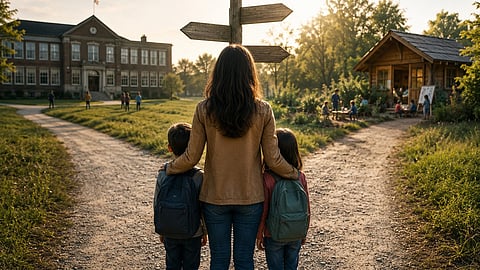
The education landscape is changing fast, and parents these days are getting more proactive about finding learning setups that match their children’s particular needs, interests, and also those longer-term aspirations. While traditional schools still matter a lot in the overall picture, more and more families are looking at alternative schooling options that can feel more adaptable, offer learning that is tailored in a way that actually fits, and support a well-rounded development instead of only academics.
This movement isn’t really a denial of regular education. It feels more like a wider realization that each child learns differently, and might do better with educational models that step outside the one-size-fits-all blueprint. And as technology keeps advancing, global connectivity expands, and career pathways keep shifting, parents are rethinking what 'quality' education means now in the 21st century, not just in theory but in day-to-day results.
The growing demand for personalized learning
One of the main reasons parents start thinking about other school paths is because there’s this urge for education that feels more personal, kind of. In regular classrooms, you know, they usually teach huge groups of students, so it ends up being a little hard to match each student's learning style, and their pace at the same time.
Aruna Yadav, CEO of SD Campus, said, "Alternative schools, online learning platforms, homeschooling programs, and hybrid education models often end up providing lessons that are more tailored. Learners can move forward based on what they already can do, they can spend a bit of extra time where things get tricky, and they can really dig into their interests in a deeper way. This sort of personalized setup can help build confidence, support stronger grades, and it may even nurture a genuine enthusiasm for learning, not just memorizing stuff for a test."
Trying to keep things holistic, modern parents are starting to notice that education really isn’t only about those report cards or the huge examinations. It feels like more and more skills, like creativity, critical thinking, emotional awareness, and emotional control, along with communication and problem solving, are being treated as just as important for what happens later on, and for overall success.
A lot of alternative schooling approaches seem to lean toward something more hands-on, like experiential learning. There are also project-based activities, arts and sports, plus leadership development that kind of runs in the background, and social emotional learning that helps kids manage themselves in real situations. The idea is to grow balanced people, not only those who do well academically, but also those who can handle life after the classroom in a practical way.
So in the end, many parents start looking for educational places that value both intellectual progress and personal maturation, kind of together, not separately.
Flexibility for diverse learning needs
Every child has their own strengths, difficulties, and interests, kind of like it’s never totally the same twice. Some students do really well inside structured settings, while others seem to shine more when they are given flexibility, plus a little bit of independence. At least, that’s what it looks like for a lot of families.
Alternative schooling options often create space for different learning needs in a way that feels smoother. For example, Kids who are involved in competitive sports, performing arts, entrepreneurship, or specialized coaching may end up benefiting from flexible timetables. That way, they can balance school alongside what they genuinely care about, and they don’t feel stuck choosing between one thing and another.
Also, students who have learning differences or specific educational requirements might find that alternative approaches are more uplifting and more welcoming than traditional settings. Usually, the guidance is more customized to the learner, not only arranged around the standard classroom routine.
Technology-powered learning chances
The upswing in digital education has, in a pretty real way, expanded access to alternative schooling possibilities, too. Online schools, virtual classrooms, and mixed learning programs now let students study from just about anywhere while still reaching high-quality educational materials, which is kind of a big deal.
Also, technology has remade how knowledge gets passed along and then absorbed. You get interactive lessons, virtual labs, adaptive learning tools, and even global teamwork opportunities. All of that makes learning experiences more engaging, compared to what many students had before, sort of.
Parents are starting to see tech-based education as a useful add-on to the usual learning path. Especially when it builds independent thinking and digital literacy, those are core abilities in today's world.
More noticeable global shifts in education
With the internet, it feels like parents can look up educational philosophies way faster than before, and compare learning patterns from many places worldwide. Things like Montessori schooling, Waldorf learning, project-based education, competency-driven learning, and international curriculum frameworks are getting more attention and also more acceptance.
"Parents are becoming better informed about different educational choices, and they start looking for programs that match their beliefs, plus their longer-term plans for their children. Because of that, this growing awareness has basically pushed numerous families to consider alternatives outside the usual schooling system, which is kind of a big change," Aruna Yadav said.
Preparing children for a changing future
Honestly, the future job market is probably going to be shaped by automation, artificial intelligence, and industries that just keep changing, fast. A lot of the jobs today’s students will end up pursuing might not even exist yet, or they could look completely different. So parents are kind of looking around for educational models that help kids stay flexible, and develop creativity, innovation, and that “keep learning” mindset for life.
A few alternative schooling approaches kinda lean into inquiry-first learning, group collaboration, and more hands-on, real-world troubleshooting. The notion is that students form a set of skills that remains useful even when everything feels a little uncertain. Rather than putting the whole focus on rote recall or standardized testing, these methods aim to prepare learners for continuous growth and for workplaces that keep shifting around them.
Making informed educational choices
More and more people seem to be looking at alternative schooling, and yet that doesn’t really mean regular schools are going away or becoming useless. It kind of points to something else, like the need to match the right educational fit to each child. Because what works exceptionally well for one student might not be ideal for another… even if they seem similar on paper.
Today’s parents have a lot more options than before, and many are taking the time to examine different routes, not just one, based on their child’s learning style, personal interests, long‑term ambitions, and day-to-day well-being. Some families think about comfort, some about structure, some just want the best fit in practice.
As education keeps changing, these alternative schooling chances are turning into an important part of the wider learning ecosystem. When families decide to embrace different teaching styles, they can shape learning experiences that help children grow and flourish academically, socially, and emotionally, in a world that keeps moving faster.
The views expressed in this article are those of the author alone. The opinions in this article do not represent the stand of Edexlive.

