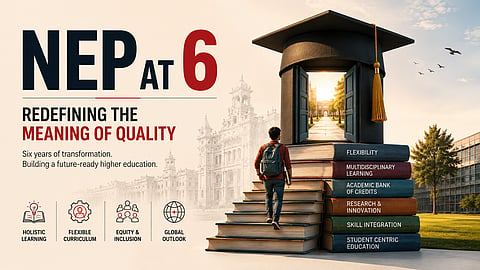


A house built on strong foundations remains rooted even in the time of adversity. Brick by brick, mortar by mortar, a house gradually takes shape. Human minds are sculpted in a similar manner. When we are born, our mind is an empty canvas – free of biases, mouldable. It is our formative years that frame our minds and the rest of our lives. And a large part of our formative years is spent in educational institutions. The quality of education disseminated to young minds in educational institutions holds a tremendous amount of power; it moulds young minds and influences their beliefs. In line with the spirit of ensuring the holistic development of such young and energetic minds of our nation, National Education Policy (NEP) 2020 was introduced in India. The aim of NEP is to make learning interactive, playful and student-centric.
Six Years of Change
The NEP envisions an education system rooted in Indian ethos that contributes directly to transforming India sustainably into an equitable and vibrant knowledge society, by providing high-quality education to all, and thereby making India a global knowledge superpower. In the last six years, since the introduction of NEP, classrooms have gone from being dreaded by children to spaces that cultivate curiosity and freedom of perspective. NEP advocates for a multidisciplinary approach where science and art are no longer at the opposing ends of a spectrum but are interrelated. It questioned the existing structure of education and introduced flexibility in curriculum. Prof Vasudha Kamat, Member of NEP Draft Committee, GoI, says “Curriculum reform is the vehicle through which the NEP vision reaches the learner. Along with curriculum, academic flexibility, faculty development (Malaviya Mission Teacher Training Centre – MMTTC), digital learning and internationalisation made the most meaningful progress.”
The NEP recommended higher education institutions (HEIs) to use the mother tongue/ local language as medium of instruction to increase Gross Enrolment Ratio (GER). “Language classes are now bringing up conversations about ethics and real-life examples to make students ready not only for exams, but more so for life, Devyani Jaipuria, pro-vice chairperson of DPS International Gurugram, said. NEP has brought in extensive change within the existing education system with the objective of building real value for students instead of rewarding rote learning. “Instead of focusing only on textual learning, NEP has prompted greater focus on the socio-emotional well-being of students. Gender sensitivity, digital empowerment, equity and inclusivity are all now included in conversations around education. PRASHAST under NEP 2020 helps identify students with learning disabilities early in life so that education can be catered to their distinct needs,” Devyani Jaipuria added.
The Implementation Challenge
Achieving successful implementation of NEP demands a long-term vision, availability of expertise on a sustained basis, and concerted action from all concerned encompassing national, state, institutional, and individual levels. "The biggest challenge is not the policy or the willingness of HEIs to implement it, but the capacity to do so. Faculty shortages, funding constraints, uneven digital infrastructure and varying institutional readiness continue to slow the pace of implementation,” Prof Vasudha Kamat said. One of the less-discussed challenges under NEP is faculty workload. Supporting this, Dr Rajendra Shinde, former principal of St Xavier's College, Mumbai, says “skill-enhancing and ability-enhancing courses often fall outside the formal workload, leaving teachers to shoulder additional responsibilities without adequate institutional support. Infrastructure was a big challenge because since we widened the number of choices to the students, the classroom availability became a problem.”
The Rise of Multidisciplinary Learning
The NEP 2020 aims to transform all HEIs into multidisciplinary institutions by 2040, promoting flexible curricula with credit-based courses in community service, environmental education and values. “We understand that the curriculum is where students actually experience NEP 2020. Once the curriculum changes, universities naturally integrate: multidisciplinary learning, skill development, society connect, technology-enabled learning, Indian knowledge systems, entrepreneurship, multiple entry-exit (MEME) and National Credit Framework (NCrF) together with the Academic Bank of Credits (ABC). Multidisciplinary education becomes much easier because of this flexibility,” Prof Vasudha Kamat added.
The Road Ahead
While NEP 2020 has laid a strong foundation for transforming higher education, there is still a long road ahead before its vision is fully realised. “Instead of introducing more reforms, universities now need to improve the quality of implementation. Universities must focus on faculty capability, research culture, employability, industry partnerships and digital transformation,” Prof Vasudha Kamat said. While supporting the change of outcome measurement, Prof Vasudha said, “Assessment process need to change. Higher level learning outcomes need to be assessed differently. It may not be through written tests, and for that new strategies need to be used where available.”
Education was never meant to be a system of ‘one-size-fits-all’, it was intended to design inclusive spaces that allow every student to explore and embrace their unique strengths instead of sticking to the convention. Although there's still a long way to go across its implementation, NEP 2020 has not only proved to be an indispensable framework for fostering creativity, critical thinking, cognitive and emotional growth of students but has also furnished an unflinching foundation for building a remarkable future.
The views expressed in this article are those of the author alone. The opinions and facts in this article do not represent the stand of Edexlive
